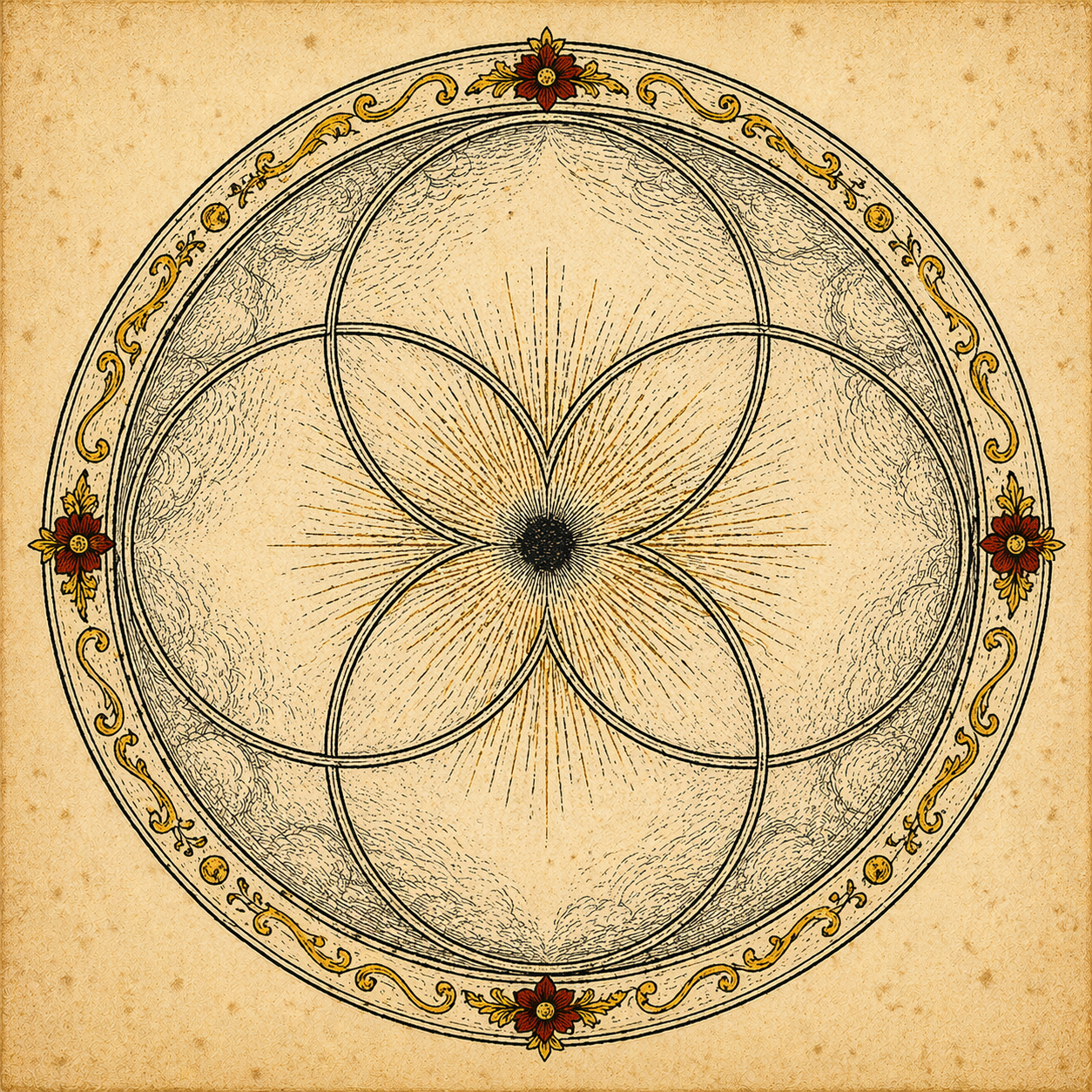
Alchemical symbol of Prima Materia: overlapping circles surrounding a central point, representing the undifferentiated source of all things

The Foundation of the Work

Prima Materia

“Verum, sine mendacio, certum et verissimum”
True, without falsehood, certain and most true.

“That which is below is like that which is above, and that which is above is like that which is below, to accomplish the miracles of the one thing. And as all things have proceeded from the one, through the mediation of the one, so all things are born of this one thing by adaptation.” The Emerald Tablet (Tabula Smaragdina), attr. Hermes Trismegistus

Three Lenses on Prima Materia

Alchemical

The Undifferentiated Substrate

The first substance from which all metals and all things are made — formless, unknowable in itself, yet the latent ground of every form. It is everywhere, costs nothing, and almost no one recognises it. Called by a hundred names, it escapes every definition.

Christian

Tohu wa-Bohu & Kenosis

The formless void of Genesis 1:2 over which the Spirit hovers; the unregenerate soul awaiting divine fire; and the self-emptying of Christ who voluntarily entered the chaos of creaturely existence — the Word made Prima Materia.

Jungian

The Unconscious

Jung identified Prima Materia with the dark, unformed psychic substrate — everything in the soul that has not yet been brought to consciousness. The Opus begins here, in the encounter with one’s own shadow: the lead-like, rejected, denied self.

I. Alchemical Foundation

The First Substance

At the origin of every alchemical treatise stands a single, bewildering postulate: before you can make anything, you must return to the thing from which everything is made. The Prima Materia — First Matter — is that thing. It is the undifferentiated substrate that underlies all metals, all substances, all beings. In the Aristotelian framework that medieval alchemy inherited, it is pure hyle: pure potentiality, matter without form, the vessel that can receive any quality but currently holds none.

Jabir ibn Hayyan (fl. 8th century, known in Latin as Geber), the foundational figure of Arabic alchemy, described Prima Materia as the single principle underlying the mineral kingdom: a substance composed of elemental qualities in different proportions, from which all specific metals deviate and to which they can theoretically be returned. For Jabir, the alchemical work was a precise, almost surgical rebalancing of these proportions. The Prima Materia was not mystical vagueness but a rigorous theoretical posit.

Yet the tradition refused to leave it at that. The Rosarium Philosophorum (c. 1550), one of the most influential late-medieval compilations, speaks of Prima Materia in language that oscillates constantly between the chemical and the mystical: it is “the root of all metals,” yet also “our chaos,” “the sea,” “the black earth.” Paracelsus (1493–1541), who transformed alchemy’s theoretical foundations, treated the Prima Materia as the universal substrate of nature from which the three principles — Sulphur, Mercury, and Salt — are distilled by the divine art.

The Emerald Tablet, perhaps the most quoted text in all of Western alchemy, situates the Prima Materia within a cosmic frame: “All things have proceeded from the one.” That primordial one — the source from which everything comes and to which the alchemist’s work returns — is the Prima Materia under its most exalted name.

The Paradox of Many Names

Nothing reveals the strangeness of the Prima Materia more than the list of names the alchemists gave it. It was called chaos, hyle, Mercurius, the sea, water, fire, earth, air, lead, dung, poison, the dragon, the toad, and many more. This is not confusion or incompetence. It is theological precision of a peculiar kind.

A thing that can be called by any name is a thing that exceeds every name. The Prima Materia is radically other to every formed thing, and so every formed thing can serve as a pointer to it — but none can capture it. The alchemists were, in their way, practising a negative theology of matter: describing the indescribable by piling up inadequate descriptions and trusting the reader to glimpse what lies behind them all.

This should sound familiar to Christian ears. The Cappadocian Fathers applied the same logic to the divine essence: God cannot be named, and therefore all names are true and none is sufficient. The Prima Materia’s resistance to definition is not a flaw in the theory. It is the theory’s most important claim.

chaos hyle Mercurius the sea water fire lead dung poison the dragon the toad prima hyle the black earth our chaos the root of all metals
In the beginning God created the heavens and the earth. Now the earth was formless and empty, darkness was over the surface of the deep, and the Spirit of God was hovering over the waters. Genesis 1:1–2 (NIV)

Christian Theological Correlates

Chaos, Creation, and the Descending Word

I. Tohu wa-Bohu: The Scriptural Prima Materia

The Hebrew phrase tohu wa-bohu (Genesis 1:2) is conventionally rendered “formless and empty,” but the words carry heavier freight. Tohu suggests a desolate, trackless waste; bohu an emptiness so complete it verges on non-being. Together they name something that is, yet barely is: existence without differentiation, being without structure, the raw material of creation in its most naked state.

This is the closest the Hebrew Bible comes to Prima Materia, and the parallel is not accidental. The alchemical tradition absorbed it consciously. The spirit (ruach) of God hovering over these waters is the Spiritus of alchemical theory — the animating divine breath that begins to work upon the formless to draw out of it the order latent within. Creation, on this reading, is the original Opus: God as the first alchemist, drawing the world out of its chaos-state into differentiated, formed existence.

II. Creatio ex Nihilo and Creatio ex Materia

Here the theologian must tread carefully. Christian orthodoxy insists on creatio ex nihilo: creation from nothing, not from any pre-existing substrate. God does not shape a resistant material; he calls being from non-being by his word alone. This guards crucial theological ground — divine freedom, divine sovereignty, the goodness of matter (which owes nothing to a malevolent anti-principle).

Alchemical hylomorphism, with its Prima Materia as eternal substrate, seems to contradict this. But the contradiction dissolves when we attend to the different levels of inquiry. Creatio ex nihilo is an ontological claim about the absolute origin of being. The Prima Materia is a cosmological and symbolic claim about how transformation works within the already-created order. Once God has spoken the world into existence, the processes of that world — including the processes of sanctification and soul-making — operate upon something: a given, unchosen, disordered raw material. The Prima Materia names that something. The two doctrines operate at different levels and need not conflict.

III. The Soul Before Grace

Origen of Alexandria (c. 184–253), in his daring cosmological speculations, envisaged the pre-existent souls as originally formless rational beings (noes) who “cooled” through neglect of the Good and fell into embodied existence. The material world is, on his reading, itself a kind of remedial Prima Materia — a theatre of purification for disordered souls. While the Church rejected the pre-existence of souls, Origen’s instinct survives: the unregenerate self is formless in the theologically significant sense, a soul that has not yet received the form of Christ.

Gregory of Nyssa (c. 335–395) is more careful and more useful. In De Anima et Resurrectione and the Life of Moses, Gregory describes the soul’s journey to God as a progressive receiving of divine form — an endless epektasis, a stretching forward into the inexhaustible beauty of God. The starting point is always a kind of darkness, a cloud of unknowing in which the soul recognises its own formlessness before the divine light. Gregory’s soul begins in chaos and moves, through grace, toward an ever-deeper participation in the divine nature. This is Prima Materia → Opus → Lapis in patristic dress.

IV. Kenosis: The Word Enters the Chaos

The most theologically audacious use of Prima Materia is Christological. St Paul writes of Christ that he “emptied himself” (ekenôsen heauton, Philippians 2:7), taking the form of a servant, being born in the likeness of human beings. In the patristic tradition, this kenosis — self-emptying — was read as the divine Son’s voluntary assumption of creaturely limitation, vulnerability, and ultimately death.

Read through the alchemical lens, kenosis is the Word’s descent into the Prima Materia. The eternal, perfectly formed Logos takes on the formlessness of flesh — enters the chaos not to be destroyed by it but to begin transforming it from within. The Incarnation is the Opus beginning at its most radical point: not the alchemist working upon the prima materia from outside, but the principle of form itself becoming matter, the first alchemist becoming the first metal.

This is not merely poetic. It is a serious theological claim with deep patristic support. Athanasius’s On the Incarnation insists that the Word took on a human nature in order to recapitulate it, reform it from within, and restore to it the imago Dei that sin had disordered. The Word, in becoming flesh, did not simply enter matter — he began the Great Work upon it.

Who, being in very nature God, did not consider equality with God something to be used to his own advantage; rather, he made himself nothing by taking the very nature of a servant, being made in human likeness. Philippians 2:6–7 (NIV)

V. Mary as Vas Hermeticum

If the Incarnation is the Opus beginning, the Virgin Mary is its first vessel. Medieval iconography of the Annunciation frequently depicts the womb of Mary as a sealed chamber — the hortus conclusus (enclosed garden) of the Song of Songs, the porta clausa (closed gate) of Ezekiel. These are images of enclosure, purity, and sealed containment: a space prepared for a transformation that cannot be contaminated from outside.

The alchemists called their sealed crucible the vas hermeticum: the hermetically sealed vessel in which the Opus was performed. C.G. Jung noted, with characteristic boldness, that the imagery of Mary’s womb in medieval Mariology maps precisely onto this alchemical concept. The sealed vessel is the condition of transformation; what goes in must not be able to escape, and nothing from outside must enter to corrupt the work.

In Mary’s womb, the divine and human natures are first united — not yet in the full Rubedo of the Resurrection, but in the initial, hidden conjoining that makes the Opus possible at all. Mary, on this reading, is not peripheral to the alchemical theology of the Incarnation. She is its necessary first instrument: the Prima Materia’s vessel, the chaos’s container, the place where formlessness begins, silently, to receive its form.
Jungian Dimension

The Dark Substrate of the Psyche

Prima Materia as the Unconscious

C.G. Jung’s central claim about alchemy — elaborated across Psychology and Alchemy (1944) and Mysterium Coniunctionis (1956) — is that the alchemists were projecting psychological processes onto matter. When they described the Prima Materia as dark, formless, containing all potentialities, resistant to definition, and yet the indispensable starting point of the Opus, they were, without knowing it, describing the unconscious.

The unconscious, for Jung, is not merely a repository of repressed memories. It is the vast, undifferentiated psychic substrate out of which consciousness itself emerges — the Prima Materia of the soul. It is everywhere (it underlies every experience) yet nowhere (it resists direct inspection); it contains all possibilities (it is the source of dreams, symbols, creativity, instinct) yet currently holds no fixed form. Most importantly, the work of individuation — Jung’s term for the lifelong process of psychological becoming — cannot begin anywhere else. You cannot skip the Prima Materia and proceed directly to the Philosopher’s Stone.

The Shadow: Prima Materia’s Human Face

In the language of Jungian psychology, the first practical encounter with the Prima Materia is the encounter with the Shadow: the dark, denied, “lead-like” aspects of oneself that have been rejected from consciousness and deposited in the unconscious. The Shadow is what the alchemist sees when he first gazes into his crucible — not gold, not even useful material, but something that looks like refuse: dung, poison, the black earth.

The alchemical tradition was honest about this. The Prima Materia must be found before it can be worked. And it is found, the texts insist, in the most despised and overlooked places — on dunghills, in excrement, in the gutter. Psychologically, this means: the beginning of self-knowledge is the willingness to look at what one has most thoroughly refused to be. The exile, the failure, the shame, the unintegrated rage — these are not obstacles to the Opus. They are its raw material.

For those in the wilderness seasons of the spiritual life — seasons of exile, of stripped identity, of the death of one’s previous self-understanding — this is not bad news. The blackness of the Prima Materia is not the absence of God. It is the presence of the unworked substance. The Opus has begun. The fact that the material is dark and unformed is not a problem to be solved but a stage to be entered.

“The prima materia has the quality of ubiquity: it can be found always and everywhere, which is to say that projection can take place always and everywhere.”

C.G. Jung, Psychology and Alchemy, CW 12, §433

Alchemical Motto

The Way Down Is the Way In

V.I.T.R.I.O.L.

“Visita Interiora Terrae Rectificando Invenies Occultum Lapidem”

“Visit the Interior of the Earth; by Rectifying, you will find the Hidden Stone.”

V Visita — Visit, descend
I Interiora — the Interior
T Terrae — of the Earth (your earth, yourself)
R Rectificando — by Rectifying, purifying
I Invenies — you will find
O Occultum — the Hidden
L Lapidem — Stone

This motto, which appears in various forms from the late 16th century onward, encodes the entire programme of the alchemical Opus in seven Latin words. It is a descent — not an ascent. The Stone is not found by rising above the material, the bodily, the dark. It is found by entering more deeply into it.

The Terra to be visited is, of course, not simply physical earth. It is the earth of the self — the body, the unconscious, the Prima Materia of the soul. The descent is the willingness to face what lies in the dark interior: the shadow, the grief, the unintegrated past. Rectificando — by purifying, by bringing attention and honesty to what is found there — the hidden stone is uncovered. Not manufactured. Not created from nothing. Found. It was already there.

The Christian ear hears in this the Descensus ad Inferos: Christ’s descent into hell, his harrowing of the very darkest place, his finding and releasing what had been imprisoned there. The Stone was hidden even in the underworld. The way to Easter passes through Good Friday and Holy Saturday. The way to the gold passes through the black earth.

From the unformed substrate, the Four Elements emerge — the first articulation of the chaos into distinguishable qualities, and the beginning of the alchemical cosmology.

Notes

1 The Emerald Tablet survives in Arabic (c. 8th–9th c.) and Latin (c. 12th c.) translations. The locus classicus for alchemical commentary is the collection in J.J. Manget, Bibliotheca Chemica Curiosa (1702).
2 On Jabir ibn Hayyan, see Syed Nomanul Haq, Names, Natures and Things: The Alchemist Jābir ibn Ḥayyān (1994); and Lawrence Principe, The Secrets of Alchemy (2013), ch. 1.
3 Gregory of Nyssa, Life of Moses, II.162–169, on the soul’s entry into divine darkness (gnophos) as the highest form of knowledge. Cf. Vladimir Lossky, The Mystical Theology of the Eastern Church (1957), ch. 2.
4 On the vas hermeticum and its Marian correlate, see Jung, Psychology and Alchemy, CW 12, §§ 303–304, 338–339; and Barbara Obrist, Les débuts de l’imagerie alchimique (1982).
5 The V.I.T.R.I.O.L. acronym appears in L’Azoth des Philosophes by Basil Valentine (attr., c. 1624) and was widely disseminated through Rosicrucian literature. See Lyndy Abraham, A Dictionary of Alchemical Imagery (1998), s.v. “vitriol.”