
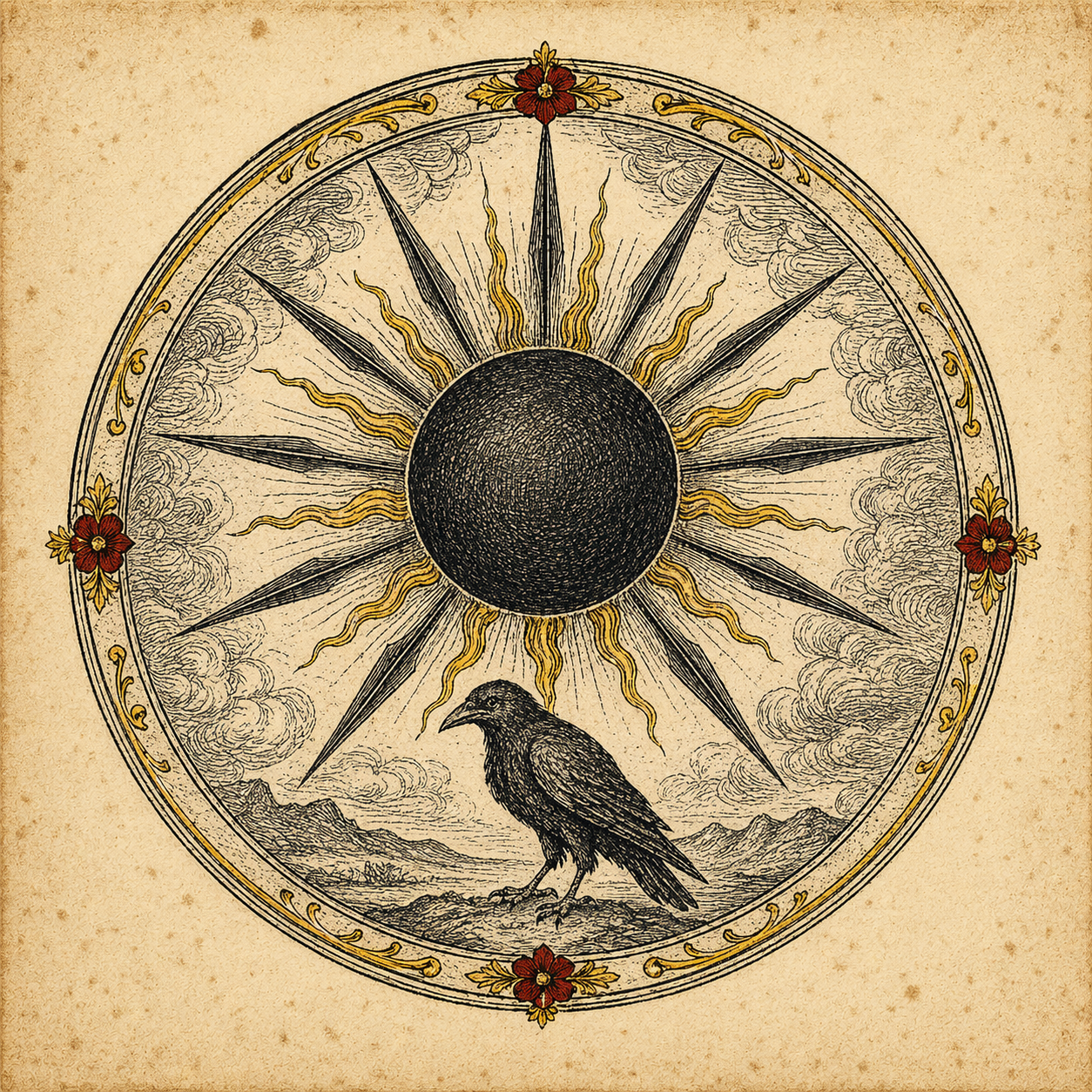
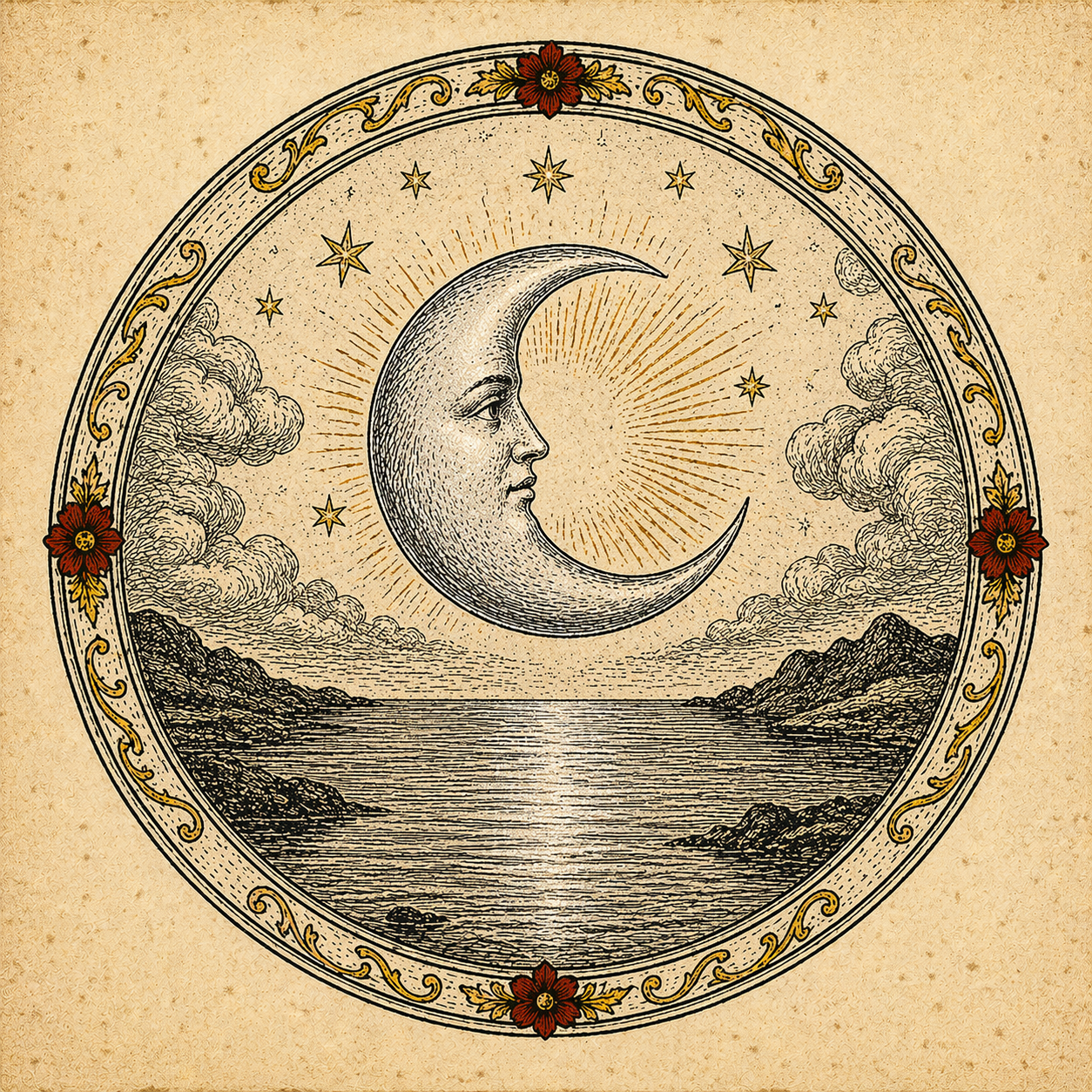

The Yellowing: Dawn Before the Solar Noon
After the silver quiet of Albedo, the matter enters its most transitional and elusive phase. Citrinitas — the yellowing, the xanthosis — is the stage in which the purified substance begins to catch the first gold of the approaching sun. If Nigredo was midnight and Albedo was moon, Citrinitas is the hour before dawn: the sky already lit, the darkness definitively past, the full solar blaze of Rubedo not yet arrived. It is the most hopeful moment in the Opus, and the most charged with expectancy.
The symbols of Citrinitas are correspondingly luminous but not yet blazing. The eagle soaring above the earth — detached from the base matter, carrying the volatile principle upward into clearer air — was the emblem chosen by many alchemists for this stage. Ripening grain, the harvest field turning gold, was another: the long patient work of growth approaching its moment of completion. The golden dawn itself, the first hour of direct sunlight after the grey pre-dawn, captures exactly the stage’s quality: not yet the full day, but no longer night.
The alchemical texts describe Citrinitas as the moment at which the matter begins to know itself — when the work turns from purification toward realisation, from the removal of impurity toward the active emergence of the stone’s own nature. The matter is not yet the Philosopher’s Stone. But for the first time, it carries within it the quality that will become the stone. It is gold in potential; it is beginning to be gold in fact.
The Progression of the Great Work
Citrinitas occupies the threshold moment — darkness definitively past, full gold not yet arrived.
Why Citrinitas Was Lost — and Why It Matters
Citrinitas has a peculiar history within the alchemical tradition: it was present in the earliest accounts of the Opus Magnum, clearly distinguished as the yellowing between white and red, and then — from around the sixteenth century, with Paracelsus and the early modern alchemists — it began to disappear. Later writers collapsed Citrinitas into Rubedo, treating the four stages as three, and the yellowing as merely the beginning of the reddening rather than a distinct phase.
The recovery of Citrinitas matters theologically and psychologically for the same reason: the transition from purity to fullness is not instantaneous. There is a mode of being — purified, oriented, already touched by wisdom — that is neither the suffering of Nigredo, nor the still receptivity of Albedo, nor yet the blazing completion of Rubedo. It is the stage of dawning understanding, of the soul that has been washed and is beginning to see. The mystics knew it. Aquinas knew it, in his distinction between scientia (knowledge) and sapientia (wisdom). The loss of Citrinitas as a named stage left a gap in the map of the spiritual life — a gap that has been filled, inadequately, by collapsing what should be a gradual dawn into a sudden leap from silver to gold.
Christian Theological Correlates
Ascension, Sophia, and the Silence Before Pentecost
I. The Ascension: Forty Days of Citrinitas
If the Christian salvation narrative is mapped onto the four stages of the Opus — Nigredo as Passion and death, Albedo as Resurrection, Rubedo as Pentecost and the full outpouring of the Spirit — then Citrinitas occupies the most luminous and theologically underexplored interval: the forty days of the Risen Christ (Acts 1:3), and the Ascension itself.
These forty days are extraordinary: the Risen Lord appears, teaches, breaks bread, breathes on his disciples — but he has not yet sent the Spirit, and the disciples have not yet become what they will be at Pentecost. They exist in an in-between time: death is definitively conquered (the Nigredo is past, the resurrection accomplished), the full glory of Rubedo is not yet manifest, and the company of disciples waits in the light of the Risen One. This is Citrinitas: transformed but not yet consummated, radiant but not yet blazing.
The Ascension itself has a Citrinitas quality — the glorified Christ ascending through the air, the disciples watching until the cloud receives him (Acts 1:9), the white-robed angels asking “Why do you stand looking into heaven?” The disciples are left with something they did not have before — an orientation, a direction, a hope — but not yet the power. They return to Jerusalem and wait. The waiting of the Upper Room between Ascension and Pentecost is the most perfect Citrinitas moment in Scripture: the dawn absolutely certain, the noon not yet arrived.
II. Sapientia: Wisdom’s Speech in Proverbs 8
Citrinitas is the stage at which Sophia — divine Wisdom — begins to make herself directly perceptible. The great Wisdom text of the Hebrew Bible is Proverbs 8, where Wisdom speaks in her own voice about her origin and her role in creation:
The Lord brought me forth as the first of his works,
the first of his acts of old.
I was formed long ages ago, at the very beginning, when the world came to be…
I was there when he set the heavens in place,
when he marked out the horizon on the face of the deep…
Then I was constantly at his side.
I was filled with delight day after day,
rejoicing before him always,
rejoicing in his whole world and delighting in the human race. Proverbs 8:22–23, 27, 30–31
This is the voice of Citrinitas: not the silence of Albedo’s moonlit receptivity, but the first clear speech of wisdom, the voice that was “constantly at his side” before creation, that rejoices in the world and in humanity. Wisdom in Proverbs 8 is not yet the full Pentecostal fire of Rubedo — she does not consume or transform by force — but she is no longer merely the still pool of Albedo. She speaks. She invites. She sets her table (Proverbs 9:2) and calls the simple to come and eat. This is wisdom in its Citrinitas form: active, radiant, inviting, and already present in the world long before the world was able to receive her fully.
The Wisdom of Solomon (7:26–29) makes the Citrinitas quality of Sophia explicit in its very language: she is “a reflection of eternal light, a spotless mirror of the working of God, an image of his goodness… more beautiful than the sun, and excels every constellation of the stars.” This is not Nigredo’s darkness or even Albedo’s silver moonlight. It is Citrinitas: gold, radiant, solar in quality but still described in terms of reflection and image — the sun not yet looked at directly, but its quality unmistakable in the light it casts.
III. Bulgakov’s Sophiology: The World as Citrinitas
The Russian Orthodox theologian Sergei Bulgakov (1871–1944) developed the most sustained Christian engagement with Sophia in the modern period — and in doing so, produced what is essentially a theology of Citrinitas, though he would not have used the alchemical language. For Bulgakov, Sophia is not a fourth divine person, nor is she simply a name for the created order, but something more precise: she is the divine ground as it shines through creation, the divine life as it is reflected and participated in by the world.
Creation, for Bulgakov, has a sophianic quality — it is not merely matter awaiting eschatological completion but already, in its depths, luminous with the divine presence it participates in. The world is, in its essence, a Citrinitas world: already touched by the gold of divine life, already bearing the image of divine wisdom, already more beautiful than a godless universe has any right to be. The task of human beings, and especially of the Church and of prayer, is to perceive this sophianic quality — to develop the capacity to see the world as it truly is.
“The world is not alien to God; it is His creation. And divine wisdom, having entered the world as its living soul, fills it from within with divine life, making the world a theophany, a revelation of God.”
Sergei Bulgakov, The Bride of the Lamb (1945), §1.3
IV. Sapientia vs Scientia: The Theologians of Dawn
The scholastic tradition distinguished sharply between scientia — systematic, discursive, methodical knowledge, the light of academic theology — and sapientia — wisdom, the contemplative knowledge that is also a form of love, the light that illuminates not by analysis but by participation. For Aquinas, sapientia is a gift of the Holy Spirit (Isaiah 11:2), not merely an intellectual achievement. For Bonaventure, the entire Itinerarium Mentis in Deum — the “Journey of the Mind to God” — is structured as a movement through types of light toward the divine light itself, with each stage of the journey giving way to a higher and more interior illumination.
This Bonaventuran ladder of lights is Citrinitas theologised: not a sudden leap from dark ignorance to full vision, but a graduated ascent in which each level of illumination reveals a new level beyond it. The contemplative who has passed through the Nigredo of purgation and the Albedo of illumination now begins to taste the quality of sapientia — not yet the unio mystica of Rubedo’s Pentecostal blaze, but a genuine, stable, illuminated wisdom that is recognisably different in kind from what preceded it.
V. “Blessed are the Pure in Heart”: The Seeing Begins
The sixth Beatitude — “Blessed are the pure in heart, for they shall see God” (Matthew 5:8) — has traditionally been understood as an eschatological promise of the beatific vision. But the mystics insisted that this seeing begins in the present life, through purity and prayer, as a genuine if partial anticipation of the fullness that awaits.
This anticipated seeing is Citrinitas. The pure heart — purified through the Nigredo’s dark work and the Albedo’s washing — begins in Citrinitas to see. Not yet the full vision (visio beatifica), which is the Rubedo of the eternal life; but a real, embodied, present-tense encounter with the divine beauty that pervades the world. The contemplative mystic who sees the sacredness of creation, who finds every created thing luminous with its Source — this is Beatitude-vision in its Citrinitas form: real, but awaiting a fullness that it knows it does not yet possess.
Jungian Dimension
The Dawning Self and the Threshold of Individuation
Jung’s Silence on Citrinitas — and What It Reveals
It is telling that Jung, whose alchemical studies were so comprehensive and detailed, gave relatively little attention to Citrinitas. His focus fell on Nigredo (Shadow confrontation), Albedo (Anima/Animus integration), and Rubedo (the Coniunctio, the union of opposites, the achievement of the Self). The yellowing stage between Albedo and Rubedo is treated, when it appears at all in his writings, as a mere transitional coloration — the matter passing through gold on its way to red.
This relative neglect may reflect something true about the psychology of the stage. Citrinitas is the most difficult phase to describe precisely because it is not a crisis or a consummation but a threshold: a state of poised readiness, of orientation toward the Self without yet being fully centred in it. The ego has been relativised (Nigredo’s work), the unconscious has been met and its feminine dimension integrated (Albedo’s work), and now the Self is beginning to orient the whole personality — but it has not yet done so with the stability and completeness of full individuation. This is a genuine psychological state, and its very subtlety may be why it so easily escapes notice.
The Senex and the Puer: The Old King Dissolving
In Jungian typology, Citrinitas is the zone of tension between the Senex (the old king, the established order of the personality, the structures that have been built up and have served their purpose) and the Puer Aeternus (the eternal youth, the new principle, the not-yet-formed but luminously present future self). In Citrinitas, the old king has lost his grip — the rigidities of the pre-Nigredo personality have been broken down — but the new king has not yet been enthroned.
This is an uncomfortable but genuinely creative state. The person in Citrinitas is no longer who they were — the old patterns, the old defences, the old certainties have been dissolved through the work of Nigredo and washed away in Albedo — but they are not yet who they will be. Something is forming. It is already golden in quality. It is beginning to speak. It is not finished.
Wisdom Displacing Reaction
The positive achievement of Citrinitas, in psychological terms, is the emergence of wisdom as a habitual quality of response. The Nigredo person reacts from wounds and compulsions; the Albedo person has cleaned the wounds but is still very much in the process of learning new patterns. The Citrinitas person has begun to act from a centre that is neither wound nor compulsion nor merely learned behaviour, but something more organic and more originary — an orientation toward what is genuinely right and real that has become second nature.
This is the psychological analogue of sapientia: not a technique, not a system, but a quality of perception and response that comes from having passed through sufficient experience to have learned — at the deepest level — what matters and what does not. The Citrinitas person is beginning to be wise. The gold is not yet fully formed, but its colour is already showing.
“Wisdom is… a reflection of eternal light, a spotless mirror of the working of God, and an image of his goodness. Although she is but one, she can do all things, and while remaining in herself, she renews all things.”
Wisdom of Solomon 7:26–27
From dawn to noon — the matter charged with gold approaches its completion. The movement toward Rubedo begins.
→Notes