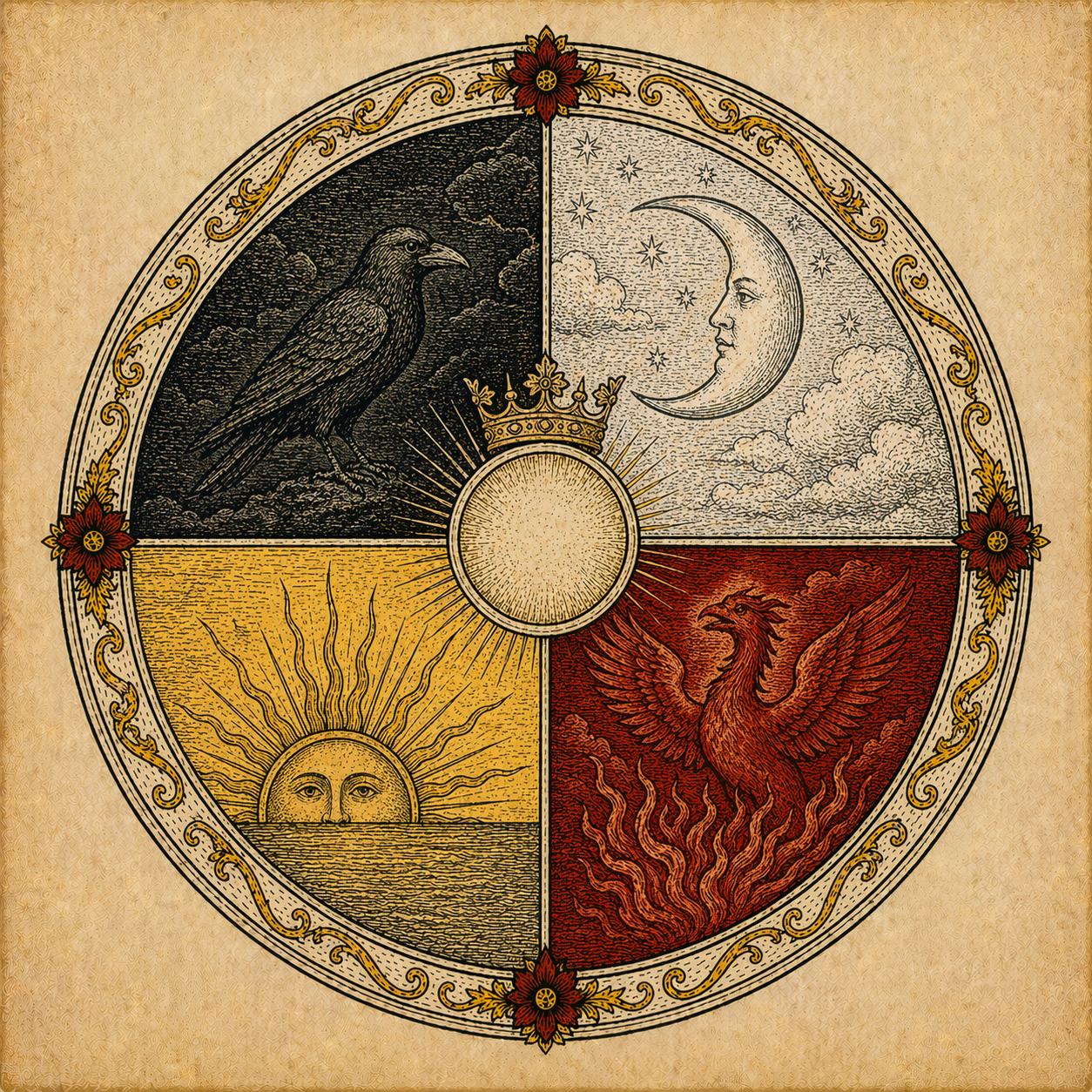
The Opus Magnum wheel: four stage segments — Nigredo, Albedo, Citrinitas, Rubedo — surrounding the Philosopher's Stone at the centre

The Opus Magnum

The Great Work — a unified map of Christian alchemical transformation

Prima Materia to Philosopher’s Stone: three interlocking languages — alchemical process, Christian salvation history, Jungian individuation — each a distinct vocabulary for one mystery of transformation.

What Is the Opus Magnum?

The alchemists called their transformative practice the Opus Magnum — the Great Work. It was not a laboratory procedure for manufacturing gold but a sacred discipline of integrated transformation: matter and soul together.

The Opus Magnum proceeds through four great stages, each with its own colour, symbol, set of chemical operations, and theological resonance. Nigredo — the blackening — is the necessary dissolution of the unpurified, the death that precedes new life. Albedo — the whitening — is purification and the emergence of reflective, lunar consciousness. Citrinitas — the dawning — marks the first light of the solar, a stage often neglected in the later tradition but vital to the full arc. Rubedo — the reddening — is the solar perfection: the sacred marriage of opposites, the coniunctio, the completion of the Work.

At the centre of the wheel stands the Lapis Philosophorum — the Philosopher’s Stone. It is both the end of the Work and, paradoxically, its hidden beginning. The Stone is discovered to have been present all along as the Prima Materia, unrecognised: lapis noster ex omnibus metallis est, et nusquam invenitur — “our stone is made of all metals and is found nowhere.” The wheel turns; the Stone endures.

The Christian reading of this process is neither fanciful nor forced. Medieval and Renaissance alchemists — many of them monks, priests, and devout laypeople — explicitly understood the Opus as a participation in the redemptive work of Christ. The blackening images the Passion and Holy Saturday. The whitening images Resurrection. The reddening images Pentecost and the glorification of the creature in God. Christ himself is the Lapis: the stone the builders rejected, the cornerstone of the New Creation (Psalm 118:22; Matthew 21:42).

Three Languages, One Mystery

Alchemical process, Christian salvation history, and Jungian individuation run in parallel — three distinct vocabularies that converge on a single arc of transformation.

Alchemical Stage Salvation History Jungian Individuation
Prima Materia
The raw, unworked chaos; undifferentiated potential; the first matter that secretly contains the Stone
Creation — the formless deep, the tohu vabohu (Genesis 1:2); the goodness of matter as yet unformed; the Spirit hovering over the waters before the first light Unconscious wholeness — the undifferentiated psyche of earliest life; the primordial Self not yet in tension with the ego; the depths from which consciousness will slowly emerge
Nigredo — Blackening
Calcinatio, putrefactio, mortificatio: dissolution, death, the dark night of the first matter; the crow’s head, the black sun
Fall, Exile, and Passion — the corruption of the good; death entering creation; the long exile from Eden; Christ descending into the darkness of Golgotha and Sheol; Holy Saturday Shadow encounter — the ego’s collision with its own darkness, the repressed, the unlived life; the painful dissolution of the persona; the dark night of the soul as psychic event
Albedo — Whitening
Ablutio, sublimatio, distillatio: the washing, the purified silver, the luminous reflective consciousness; the white rose, the moon
Resurrection and Baptism — the white light of Easter morning; the linen cloths; baptism as the washing and reclothing of the soul; the Church’s receptive, lunar character as Bride of Christ Anima/Animus encounter — meeting the contrasexual soul-image; the night-sea journey through the deep unconscious; developing inner receptivity and the capacity for depth and symbol
Citrinitas — Dawning
The lost or neglected stage; the golden dawn between white and red; sapientia beginning to orient the soul before the full solar culmination
Resurrection Morning — the first barely-visible light of Easter; the disciples on the road to Emmaus, not yet recognising; the dawning knowledge of the Risen Christ before the full Pentecostal fire First emergence of the Self — wisdom begins to displace ego-reactivity; the ego starts to be oriented by the deeper centre rather than by persona or shadow; still partial, still only dawn
Rubedo — Reddening
Coagulatio, fermentatio, multiplicatio, projectio: the solar completion, the Coniunctio Oppositorum — king and queen, sun and moon, fixed and volatile united
Pentecost and Deification — fire descends; the Church is reddened by the Spirit; theosis (2 Peter 1:4); the Wedding of the Lamb (Revelation 19); the creature truly participating in the divine nature Achievement of the Self — the union of conscious and unconscious, masculine and feminine, shadow and light; the totus homo; the individuated person whose wholeness becomes an instrument of transformation in others
Lapis Philosophorum
The Stone that transmutes all it touches; the universal tincture; paradoxically both the end and the secret beginning; nostra materia et finis noster
The New Creation — the Eschaton; the Wedding of the Lamb; the New Jerusalem of pure gold and crystal (Revelation 21–22); the rejected stone become cornerstone; grace as universal medicine perfecting all it enters Individuation as ongoing gift — not a state achieved once but a dynamic, deepening orientation; the individuated person who transmutes others by their very presence; the Stone’s multiplicatio made personal

The Soror Mystica

Soror Mystica — Mystical Sister

The Contemplative Companion

In the alchemical tradition, the Soror Mystica — the mystical sister — is the indispensable feminine counterpart to the male alchemist. She is not his assistant but his complement: the receptive, contemplative, intercessory dimension without which the Work cannot be completed. In the iconography of the Rosarium Philosophorum and related texts, the coniunctio of King and Queen, Sol and Luna, is the central image of the Opus — and neither principle can achieve the Work alone.

For the Christian reader, the Soror Mystica resonates on several levels simultaneously. She images the Ecclesia — the Church as Bride of Christ, whose receptive fidelity is integral to salvation history. She images the Blessed Virgin, whose fiat is the hinge-point of the Incarnation: the supreme moment when divinity took on the lead of human flesh, transforming the base into the gold. She images, in Jungian terms, the Anima — the soul-image, the inner feminine — whose integration is necessary for the wholeness of the Opus.

The tradition of Sophia — divine Wisdom — runs from Proverbs 8 through the Greek Fathers, through Bulgakov’s sophiology, and through the alchemists’ veneration of their prima materia as feminine. She is not a goddess competing with the Trinity but a dimension of God’s own self-communication: the gentle, beautiful, relational face of the Word through which the world was made and in which it is redeemed.
The Circulatio

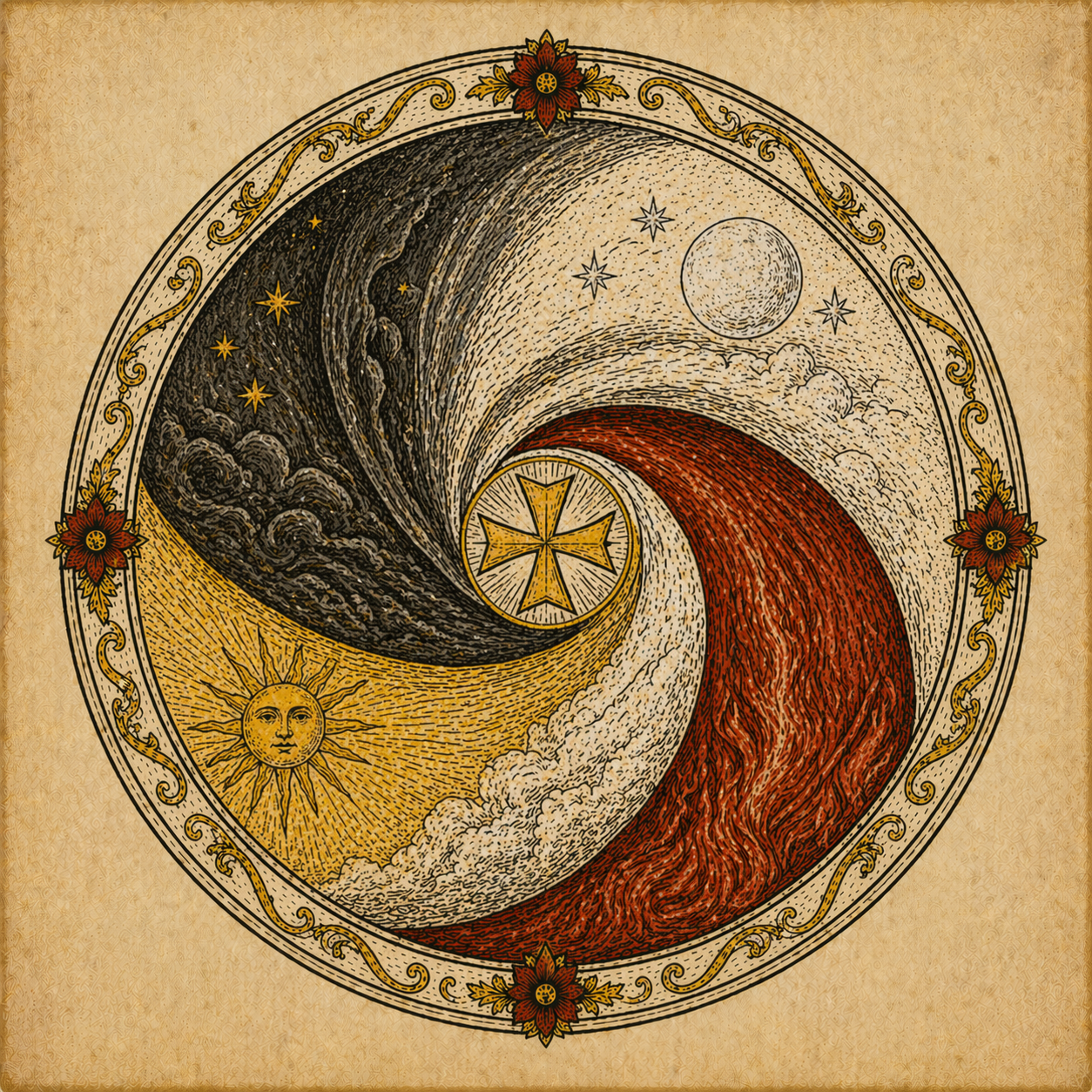
The Opus Magnum is not a linear once-for-all event but a recurring deepening cycle — a spiral through the same territory at ever greater depth.

Circulatio: cyclical transformation diagram showing the recursive movement of the Opus Magnum around the central Stone

Spiral, Not Line

Medieval alchemists were clear: the Opus Magnum is not a one-time linear sequence but a circulatio — a circulation, a spiralling return. The matter is calcined, dissolved, distilled, and coagulated not once but many times, with each pass deepening and purifying what the previous cycle only began. The wheel keeps turning; the centre keeps drawing.

Spiritually, this means that the dark nights are not left behind but revisited at greater depth. The Albedo purity achieved at one stage of life will yield to a new Nigredo at the next. The Rubedo completion is always also a new beginning — the stone becoming Prima Materia once more for a higher, subtler Work. Each revolution of the wheel is not regression but ascent.

The Christian doctrines of ongoing conversion (metanoia), purgation, and sanctification follow the same logic. Theosis is a movement, not a destination; the saints grow from glory to glory (2 Corinthians 3:18), not from baseline to finish line. The alchemical circulatio images nothing less than a doctrine of grace operating through time.

Delve into the Great Work

Every module in the Aurum Cordis study — from foundational alchemical principles to the full Opus, the planetary cosmology, and the depth-psychological dimension.

Prima Materia

The Unformed Substrate

The undifferentiated first substance — chaos before creation, shadow before light, the soul before grace.

The Four Elements

Earth · Water · Fire · Air

The elemental grammar of the cosmos — from Aristotle to liturgy, from matter to sacrament.

Tria Prima

Sulphur · Mercury · Salt

Paracelsus’ triad of essence — soul, spirit, and body in symbolic chemistry.

Nigredo

Stage I — The Black Phase

Dissolution, putrefaction, dark night. The collapse of false form before transformation.

Albedo

Stage II — The White Phase

Purification, lunar reflection, and renewal. The whitening after the blackness.

Citrinitas

Stage III — The Yellow Phase

The lost stage. Solar wisdom dawning. Sophia. The threshold before fullness.

Rubedo

Stage IV — The Red Phase

Solar perfection, the coniunctio. Pentecost. Theosis. The Wedding of the Lamb.

The Philosopher’s Stone

Lapis Philosophorum

The Stone that is not a stone. Christ as Lapis. Grace as universal tincture.

The Seven Metals

Planetary Rulers

Lead to Gold: the planetary ladder of transformation and Dante’s Paradiso.

The Opus Magnum

The Great Work — Full Map

Unified overview: alchemy, salvation history, and Jungian individuation in parallel.

Jung & Alchemy

Depth Psychology & Faith

Where Jung converges with Christian theology — and where they part ways.

Bibliography

Sources & Further Reading

Primary alchemical sources, Christian theology, Jung, and integrative scholarship.

Theological Cross-Reference Index

Searchable Index

Search every alchemical term by theological correlate, scripture reference, or Jungian concept. Filter across the full corpus in one view.

Ora et Labora

“We are always beginners in the spiritual life — and the Opus
never ends; it only deepens, turn by turn.”

From every completed cycle, the matter returns — purified, made more subtle, more capable of receiving the next illumination. The circulatio continues. Ora et labora — pray and work — and trust the fire.