Alchemical Theory
The Stone That Is Not a Stone
Rosarium Philosophorum, c. 1550
“Lapis noster non est lapis”
“Our stone is not a stone”
This paradox, repeated in varying forms across centuries of alchemical writing, is not an evasion but a precision. The alchemists were at pains to insist that the Lapis Philosophorum is not a material object that can be found lying on the ground, purchased, stored on a shelf. It is a substance in the alchemical sense — a perfected principle, a quality of transmutation that cannot be contained in any merely physical description. It is found everywhere and found by almost no one. It costs nothing and costs everything. Every person has encountered it and almost no one has recognised it. The paradox is the point: what cannot be grasped by ordinary categories can only be indicated by the collision of ordinary categories against each other.
The Lapis Philosophorum — the Philosopher’s Stone — is the goal toward which the entire Opus Magnum has been directed, and yet it is not simply the product of the work. The alchemical tradition insists on a deeper paradox: the Stone was present in the Prima Materia from the very beginning. The work did not create it; the work revealed it. The Prima Materia already contained the Lapis in potential, as the seed contains the tree, as the rough ore contains the vein of gold. The Opus is the process of uncovering what was always there.
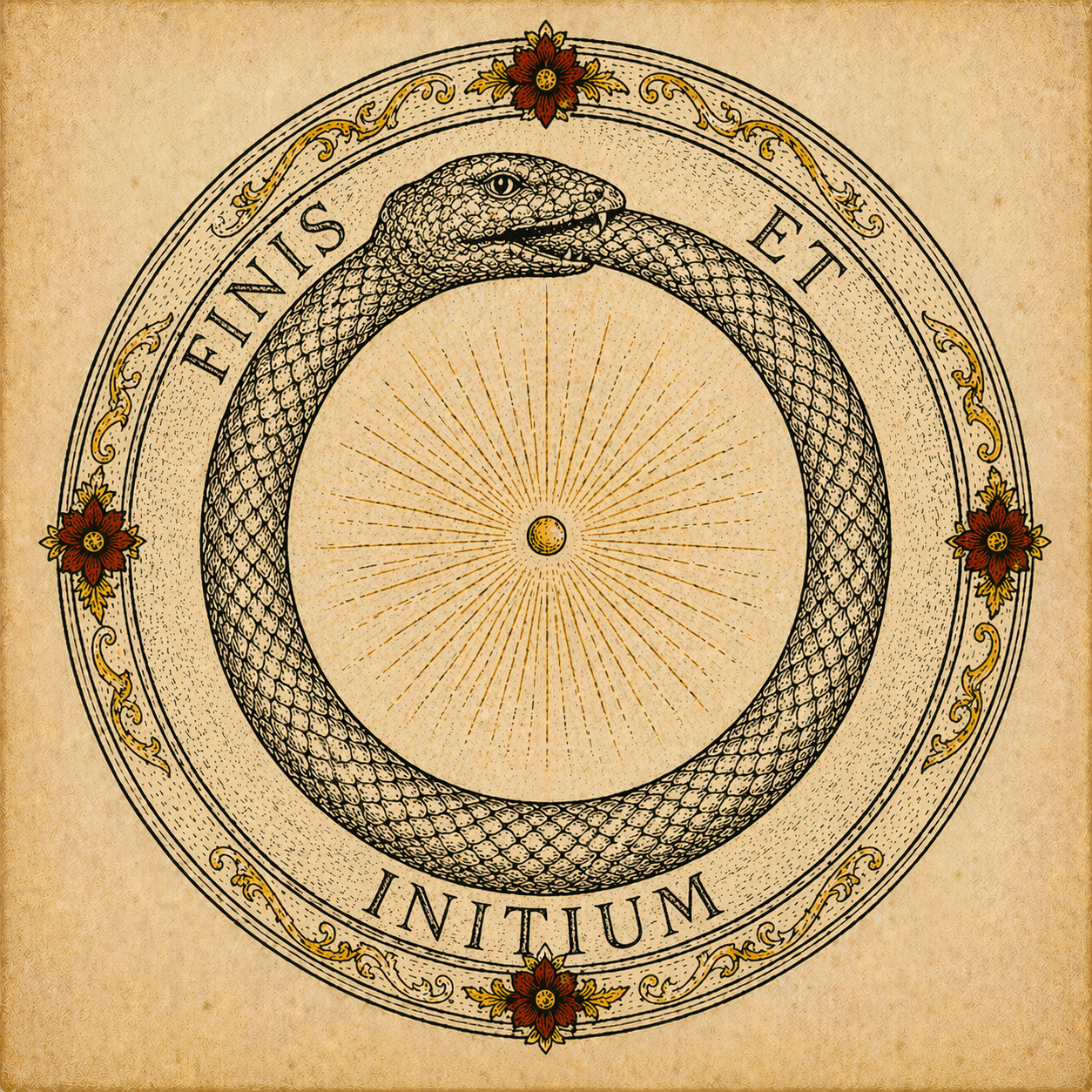
This is encoded in the ouroboros — the great symbol of the Stone: the serpent devouring its own tail, the circle that has neither beginning nor end, the emblem of the work that returns to where it started and finds what it was always looking for. In cauda venenum — in the tail the poison; in the tail, also, the antidote. The end of the work is the beginning recognised for the first time.
Three Grades and the Universal Medicine
The alchemical tradition distinguished three grades of the Stone, corresponding to the three levels of the work’s completion. The white stone (lapis albus) is the achievement of Albedo — able to transmute base metals into silver, the lesser work. The red stone (lapis rubeus) is the achievement of Rubedo — able to transmute into gold, the greater work. Above both is the universal medicine (medicina universalis), the Stone in its fullest development: not merely a transmuting agent for metals but a healing principle for all things — the Elixir Vitae (Elixir of Life), the Alkahest (Universal Solvent), the Panacea.
These three grades suggest an important theological point: the Stone does not operate at only one level. It works on matter, but also on soul, and also on spirit. The Christian theologian recognises here the triple effect of grace: sanctification (the working on disordered passions), illumination (the working on the darkened mind), and union (the direct participation in the divine life). Three grades of one tincture; one tincture at three depths.
Christian Theological Correlates
Christ as Lapis: The Stone the Builders Rejected
The identification of Christ with the Philosopher’s Stone is not a modern imposition. It runs through the Christian alchemical tradition from its earliest sources:
| Source | Identification | Key Text / Image |
|---|---|---|
| Psalm 118:22 | The rejected stone becomes the cornerstone | “The stone the builders rejected has become the cornerstone; the Lord has done this.” Applied to Christ in Matthew 21:42 and 1 Peter 2:7. |
| Zosimos of Panopolis (c. 300 AD) | The Stone as the divine man who descends and ascends | In his visions, Zosimos describes a figure — half divine, half suffering — who undergoes dismemberment and resurrection. Early Christians read this as a figure of Christ. He is the oldest surviving alchemical writer. |
| Aurora Consurgens (c. 13th c., attr. Aquinas) | Wisdom / Lapis identified with the bride of the Song of Songs and with Christ | This extraordinary text weaves alchemical and biblical imagery together with explicit christological intent. Whether Aquinas wrote it remains contested; its theology is unmistakably Christian and high medieval. |
| John of Rupescissa (c. 1350) | The Quintessence as the “heavenly” body of Christ | In De Consideratione Quintae Essentiae, Rupescissa identified the alchemical quintessence with the glorified body of Christ and with the Eucharist — the body that feeds and heals. |
| Thomas Aquinas, Adoro Te Devote | Christ in the Eucharist as universal tincture | “A single drop, for sinners spilled, / Is ransom for a world from guilt and woe.” The multiplicatio of the Stone in sacramental language: infinite power in the smallest quantity. |
| Martin Luther (1518, Operationes in Psalmos) | The rejected stone as the Word of God | Luther’s early lectures on Psalm 118 develop the rejected-cornerstone theme extensively, identifying the Lapis with the Gospel itself: cheap and available to all, yet despised by the wise and powerful. |
I. The Stone the Builders Rejected
The scriptural resonance between the Philosopher’s Stone and Christ is at its most explicit in the rejected-cornerstone tradition. The alchemical Stone is, by definition, the thing that is overlooked: common, cheap, found everywhere, despised. The tradition insisted that it lay in the street, that every person had passed by it without recognising it, that it was the last thing the sophisticate would think to examine. And yet it is the one thing necessary.
Jesus applies Psalm 118:22 to himself with deliberate provocation (Matthew 21:42): the authorities who have just questioned his authority are the builders; he is the stone they have already decided to reject. The identification is alchemically precise: the Lapis is not recognised by the learned, the powerful, or the professionally religious. It is found by the poor in spirit, the humble seeker, the person who has been through enough Nigredo to stop trusting their own categories. Peter pushes the metaphor further: “a living stone — rejected by humans but chosen by God” (1 Peter 2:4); and “the stone the builders rejected has become the cornerstone” (1 Peter 2:7). The rejected stone does not merely survive rejection. Rejection is the condition of its becoming the cornerstone.
As you come to him, the living Stone — rejected by humans but chosen by God and precious to him — you also, like living stones, are being built into a spiritual house to be a holy priesthood, offering spiritual sacrifices acceptable to God through Jesus Christ. 1 Peter 2:4–5
II. The Hidden Treasure and the Pearl of Great Price
Two of Jesus’s parables in Matthew 13 map directly onto the alchemical quest for the Stone. The man who finds treasure hidden in a field — who in his joy goes and sells everything to buy that field (Matthew 13:44) — is the alchemist who has glimpsed the Lapis. The merchant who finds a pearl of great price and sells all he has to possess it (Matthew 13:46) is the alchemist who abandons every other pursuit when the Stone comes into view. Both parables insist on the same things: the object is already present in the world (not fabricated), it is recognised by those who are prepared to see it, and the appropriate response is total divestment of everything else.
The alchemical tradition made the same point in its own way: the Stone costs nothing in money but everything in the self. It cannot be purchased but can be found. The wise fool who wanders the earth looking for it everywhere while it lies in his own garden is one of the tradition’s most beloved images — theologically, this is the soul searching for God in exotic systems and distant places while grace is the very air it breathes and the ground under its feet.
“The kingdom of heaven is like treasure hidden in a field. When a man found it, he hid it again, and then in his joy went and sold all he had and bought that field.
Again, the kingdom of heaven is like a merchant looking for fine pearls. When he found one of great value, he went away and sold everything he had and bought it.” Matthew 13:44–46
III. The Kingdom as Leaven: Fermentatio in the World
“The kingdom of heaven is like leaven that a woman took and hid in three measures of flour, till it was all leavened” (Matthew 13:33). This is the fermentatio quality of the Stone in Gospel language: a small, hidden, seemingly negligible quantity that works through the whole mass by contact, transforming without being transformed, spreading without being spread thin.
The parable of the leaven is a description of how the Kingdom — which is to say, how grace — works. It does not operate by force, by proclamation, by visible imposition. It operates by the hidden contact of a transforming principle with the material it enters. The Church embedded in culture, the Christian embedded in a community, the saint whose quality of presence leavens the whole group — these are the Stone at work, the fermentatio proceeding as it was designed to: quietly, pervasively, irreversibly.
Theological Synthesis
Grace as Universal Tincture
Gratia perficit naturam
Aquinas’s axiom — “grace perfects nature” (gratia perficit naturam, Summa Theologiae I, q. 1, a. 8) — is the theological equivalent of the alchemical principle of the Lapis as tincture. The tincture does not destroy the metal it enters; it elevates it, perfects it, brings it to the fullness of what it was always capable of being. The base metal does not cease to be metal when it becomes gold; it becomes the most excellent form of what it always was.
Grace does not destroy human nature but perfects it. The graced human being is not less human — not a ghost or an angel or something post-human — but more human: more genuinely rational, more genuinely free, more genuinely loving than the ungrace state can achieve. The theological tradition from Aquinas through to John Paul II’s theology of the body insists that grace is not the imposition of a foreign principle onto human nature but the activation of what human nature most deeply is. The gold was always latent in the lead; grace makes the latency actual.
This has profound implications for how the Christian reads the Philosopher’s Stone. The Stone is not magic — not the imposition of a miraculous external power on an inert passive recipient. It is the intensification of what was already there, the perfection of the inherent goodness of creation by its Creator’s own life communicated. When the Stone touches base metal, it is not introducing something entirely alien. It is introducing the metal to itself — to the gold it was always capable of being, to the form that was always its own truest form. “I came that they may have life, and have it abundantly” (John 10:10). Not a different life. Abundant life. The same life, raised to its highest power.
Jungian Dimension
The Lapis as the Self: The Centre That Was Always There
The Self as the Stone
For Jung, the Philosopher’s Stone is the most adequate symbol available for what he called the Self — the transcendent centre and totality of the psyche, which is both the goal of individuation and its ever-present ground. The Self is not created by the psychological work; it is revealed by it. Like the Stone in the Prima Materia, the Self was present from the beginning — it is the deep structure of the psyche that precedes the ego, outlasts its crises, and gradually orients the whole personality around itself when the work goes right.
This is why the ouroboros is the supreme symbol of both the Stone and the Self: the end of the work is the recognition of what was there at the beginning. The individuation process does not produce the Self; it removes what obscures it. The Nigredo removes the false self of the persona; the Albedo washes away the projections and compulsions; the Citrinitas begins to orient the ego toward a deeper centre; and in Rubedo, the Self at last becomes the stable ground of conscious life. But the Self was always the ground. Individuation is the process of discovering what was always true.
The Paradox of the Stone: Found at the End, Present from the Beginning
In his late autobiographical reflections — recorded in Memories, Dreams, Reflections (1962) — Jung returned again and again to the paradox of the Stone. The work of a lifetime of depth psychology, he said, had led him back to something he knew as a child: the sense of a ground beneath the ground, a presence larger than the ego, a “personality No. 2” that was always there, always more fundamental than the anxious professional self that navigated the world.
He described a stone in his childhood garden — a particular stone on which he would sit — and his sense that the stone was somehow him, or he was somehow the stone: a solidity, a groundedness, a being-that-simply-is, contrasted with the flux of consciousness and personality above it. This early image of the stone as the ground of being is the psychological ouroboros: the child’s intuition of the Self, glimpsed before the ego’s elaborations, returned to only at the end of a lifetime of work. The Lapis was in the Prima Materia. It was there all along.
“The self is not only the centre but also the whole circumference which embraces both conscious and unconscious; it is the centre of this totality, just as the ego is the centre of the conscious mind.”
C.G. Jung, Psychology and Alchemy, CW 12, §44
The Stone has been named. Now the map of the Great Work — the full Opus Magnum set out in its seven metals and planetary correspondences — awaits.
→Notes