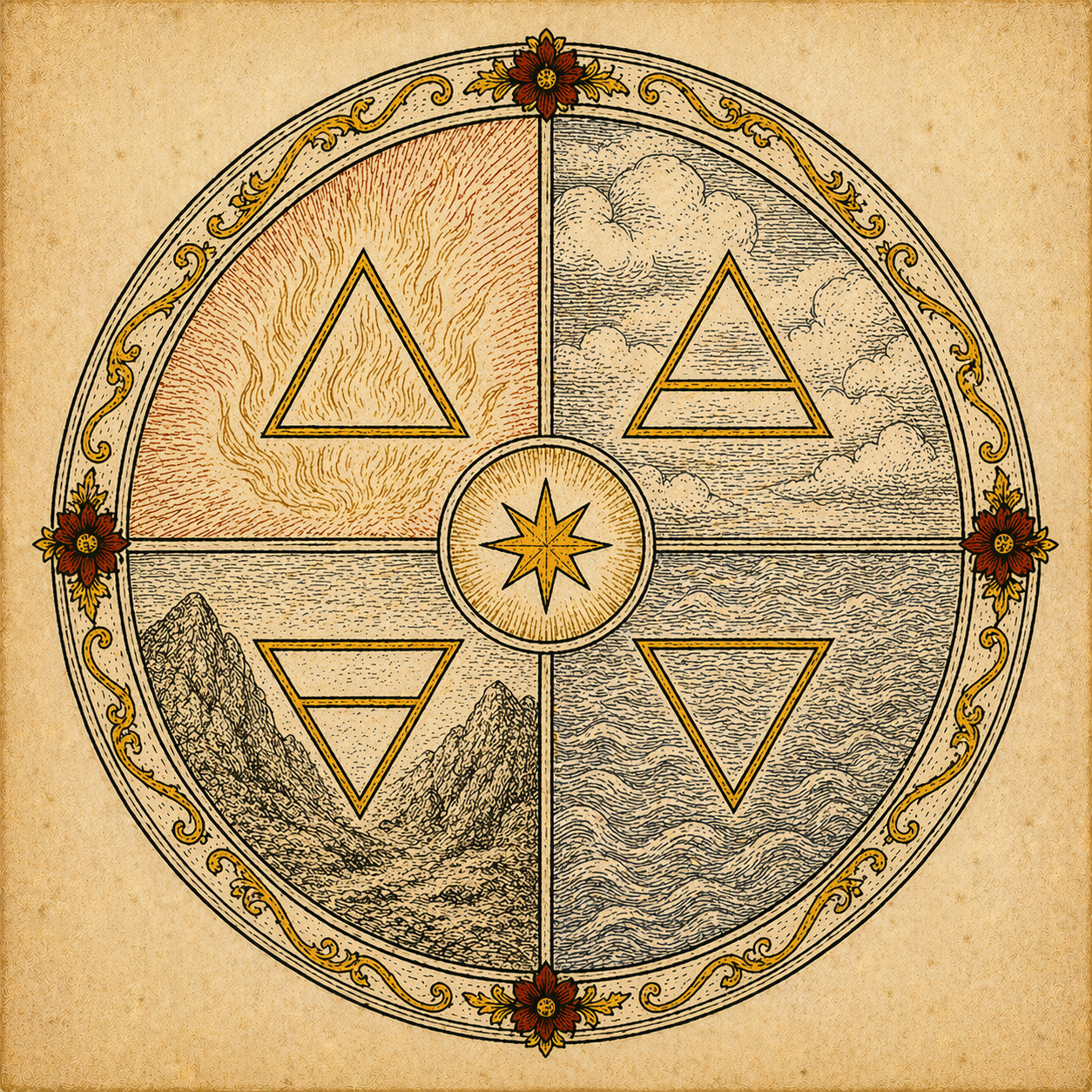
The Four Elements — alchemical diagram of Earth, Water, Air, Fire and the Quinta Essentia

The Classical Quaternary

The Four Elements

Earth, Water, Air, Fire — and the hidden fifth that unifies them all

“He is before all things, and in him all things hold together.” Colossians 1:17

Alchemical Theory

The Aristotelian Quaternary

Select an element to explore its qualities, theological resonance, and Jungian function

HOT WET COLD DRY 🜂 FIRE 🜁 AIR 🜄 WATER 🜃 EARTH Quinta Essentia
Select an element to explore its alchemical qualities, Christian theological correlate, and Jungian function.
🜂
Fire
Ignis
Hot Dry

The agent of calcination. Fire separates subtle from gross, burns away impurity, raises the volatile. It is the most active element — the principle of transformation itself.

Pentecost (Acts 2); the burning bush (Exodus 3); the pillar of fire (Exodus 13); the seraphim (Isaiah 6); God as consuming fire (Hebrews 12:29). The Holy Spirit descends as tongues of fire.

Intuition — leaping beyond present data toward invisible possibilities. The prophetic capacity to see the future in the flame.

🜁
Air
Aer
Hot Wet

The mediating element between fire above and water below. Air carries the spiritus and enables sublimation — the upward movement that purifies the volatile.

The breath of God (ruach, pneuma); the Spirit as wind (John 3:8); resurrection breath (John 20:22); the still small voice after the wind (1 Kings 19:12).

Thinking — the ordering, analytical capacity that connects concepts and builds bridges between inner and outer reality.

🜄
Water
Aqua
Cold Wet

The solvent and womb. Water dissolves fixed forms (solutio), receives and transmits, and is the medium of purification. The prima materia was often called “our water.”

Baptism and the waters of creation (Genesis 1:2); the Jordan; living water (John 4, 7); water from Christ’s side (John 19:34); flood and new creation (1 Peter 3:20–21).

Feeling — the receptive, relational capacity that registers the worth and meaning of things; depth in which meaning is felt rather than reasoned.

🜃
Earth
Terra
Cold Dry

The fixed, the stable, the vessel that receives. Earth is the element of coagulatio — fixing the volatile into permanent form. Grave and ground; end of the downward arc, base for the upward.

The Incarnation — the Word made dust (Genesis 2:7; John 1:14); the Body of Christ; Eucharistic bread; burial and resurrection; the new earth (Revelation 21:1).

Sensation — the grounded engagement with physical reality and the body’s testimony; trusts only what can be touched, weighed, measured.

Quinta Essentia
The Fifth Element

The hidden principle distilled from the four — pure, incorruptible, neither hot nor cold, wet nor dry. The goal of repeated distillation: the celestial nature latent in earthly matter.

Christ as the unifying principle in whom all things cohere (Colossians 1:17). Sophianic wisdom as the hidden intelligibility of creation. The Spirit who unifies the four without being reducible to any.

The Self — the transcendent centre that holds all four functions in balance. Not a fifth faculty but the living ground in which all four participate.

Transmutation Through Adjacent Qualities

The elemental wheel encodes a theory of change. Each element shares one quality with its neighbour: Fire and Air share Heat; Air and Water share Wetness; Water and Earth share Cold; Earth and Fire share Dryness. To transmute one element into the adjacent one, only a single quality need change — a principle that made elemental transmutation seem not only possible but logically inevitable.

This is why the alchemical tradition was so thoroughly Aristotelian. The wheel provided the theoretical scaffolding for alchemy’s central claim: that base matter can be refined into noble matter, that lead contains gold in potential, that the Prima Materia is secretly the Philosopher’s Stone in an unworked state. Change is possible because the elements are not separate substances but modulations of a single underlying substrate.

Christian Theological Correlates

The Elements in Scripture and Sacrament

Fire — Ignis

HotDry

The burning bush that is not consumed (Exodus 3:2) — divine fire that illuminates and transforms without destroying. The pillar of fire guiding Israel (Exodus 13:21) — fire as presence and protection. At Pentecost, tongues of fire rest on the disciples (Acts 2:3): the Spirit chooses fire as his sign. Isaiah’s seraphim cry “Holy, holy, holy” before the divine fire-throne (Isaiah 6). God himself is a consuming fire (Deuteronomy 4:24; Hebrews 12:29).

The first operation — calcination — reduces to ash. But fire does not destroy; it purifies. The Spirit’s fire does the same: it burns away what is not of God without annihilating the soul.

“They saw what seemed to be tongues of fire that separated and came to rest on each of them.” Acts 2:3

Water — Aqua

ColdWet

Water is the most theologically saturated element. It appears at the beginning (Genesis 1:2), at the centre (baptism in the Jordan), and at the end (Revelation 22:1 — the river of the water of life). John’s Gospel gives it unique depth: living water for the Samaritan woman (John 4:14), rivers of living water from the believer’s heart (John 7:38), water from Christ’s pierced side (John 19:34) — read by the Fathers as baptism and Eucharist simultaneously.

Water as solutio: it dissolves fixed forms and is the receptive medium of purification. Baptismal water is solutio — dissolving the old self to make way for the new.

“The water I give them will become in them a spring of water welling up to eternal life.” John 4:14

Earth — Terra

ColdDry

“The Lord God formed a man from the dust of the ground and breathed into his nostrils the breath of life” (Genesis 2:7). Humanity is earth animated by divine breath — the lowest element given the highest gift. The Incarnation redoubles this: the eternal Word takes on our earthen nature (John 1:14), is buried in the earth and rises from it. The Eucharist is earthen theology: bread and wine from ground and vine. The new creation (Revelation 21:1) is a new earth — not the abolition of the earthly but its transformation.

“The Word became flesh and made his dwelling among us.” John 1:14

Air — Aer

HotWet

Air is the element of divine communication: the ruach of Genesis, the pneuma of the New Testament (John 3:8 — “The wind blows wherever it pleases”), the resurrection breath Jesus breathes on the disciples (John 20:22). Elijah meets God not in earthquake or fire but in the still small voice — the gentle air after the violence (1 Kings 19:12). The Spirit of God moves invisibly, powerfully, and freely, like wind.

Air as sublimatio: the rising of the volatile, the upward movement that carries the purified substance toward the light. The Spirit’s role in the soul’s ascent.

“The wind blows wherever it pleases… So it is with everyone born of the Spirit.” John 3:8

Quinta Essentia

The Fifth Element — The Hidden Unifier

Medieval natural philosophers inherited from Aristotle a fifth element beyond the earthly four: aether, the incorruptible substance of the celestial spheres, neither hot nor cold, wet nor dry. Alchemists translated this into the quinta essentia: the hidden fifth nature that could be distilled, through repeated purification, from any of the four elements — the healing tincture, incorruptible, penetrating, vivifying, and the goal of the entire work.

The Christological reading is irresistible and was made explicitly by medieval writers. If the four elements map to the created order in its diversity, then Christ — “in whom all things hold together” (Colossians 1:17), the Logos “through whom all things were made” (John 1:3) — is the quinta essentia of creation. He is not one of the elements but the principle by which they cohere. The Sophianic tradition, from Proverbs 8 through Bulgakov, elaborates this further: Divine Wisdom is the hidden intelligibility of creation — the fifth nature that is not outside it but hidden within, waiting to be distilled by the patient work of love and attention.

The Son is the image of the invisible God, the firstborn over all creation. For in him all things were created: things in heaven and on earth, visible and invisible… He is before all things, and in him all things hold together. Colossians 1:15–17

Jungian Dimension

The Fourfold Typology

Jung’s four psychological functions — Thinking, Feeling, Sensation, Intuition — are not an arbitrary taxonomy. They are a rediscovery of a quaternary structure as old as the Hippocratic temperaments, the four humours, and the four elements. The parallels are structural: the elements and the functions are different vocabularies for the same fourfold organisation of human experience.

Each person has a dominant function (most developed, most reliable) and an inferior function (least developed, most unconscious, most compensatory). The inferior function behaves like a repressed element: it returns in dreams, projections, and symptoms precisely because it has been denied. The alchemist’s work of tending all four elements corresponds to the individuation task of developing enough awareness of all four functions that none operates in pure unconsciousness.

Element Qualities Jungian Function Character
🜂 Fire Hot + Dry Intuition Leaping, prophetic, future-oriented; sees the invisible pattern behind the visible
🜁 Air Hot + Wet Thinking Ordering, connecting, analytical; builds bridges between concepts and reality
🜄 Water Cold + Wet Feeling Receptive, relational, value-oriented; registers worth and meaning
🜃 Earth Cold + Dry Sensation Grounded, empirical, present; trusts the body and the immediate evidence
✦ Quinta The Self Transcendent centre; not a fifth function but the ground integrating all four

The quinta essentia as the Self is Jung’s most theologically resonant idea. The Self is not the ego enlarged; it is a centre that transcends the ego while including it. It holds the four functions in a living relationship, not by subordinating three to one, but by being the ground in which all four participate. For the Christian, this is the imago Dei in the soul: not a faculty alongside the others, but the divine presence that makes the whole person coherent.

“The quaternity is one of the most widespread archetypes and has proved to be one of the most fruitful symbols in psychological typology… It is the formula for the Self, the totality of the personality.”

C.G. Jung, Psychology and Alchemy, CW 12, §327

Within the quaternary, Paracelsus discovered a deeper trinity: Sulphur, Mercury, and Salt — the three principles of body, soul, and spirit that structure all things.

Notes

1 On Aristotle’s elemental theory and its alchemical reception, see Lawrence Principe, The Secrets of Alchemy (2013), ch. 2; William Newman & Lawrence Principe, Alchemy Tried in the Fire (2002).
2 The Christological reading of the quinta essentia appears in Roger Bacon, Opus Maius (c. 1267) and the broader tradition of Christian natural philosophy. See Lyndy Abraham, A Dictionary of Alchemical Imagery (1998), s.v. “quinta essentia.”
3 On Bulgakov’s Sophiology, see Sergius Bulgakov, Sophia: The Wisdom of God (1937); Rowan Williams, Sergii Bulgakov: Towards a Russian Political Theology (1999).
4 Jung’s typological system is in Psychological Types (CW 6, 1921). For elemental parallels, see Marie-Louise von Franz, Alchemy: An Introduction to the Symbolism and the Psychology (1980).