I. The Passion: The Sol Niger of Salvation History
The crucifixion of Christ is, on any serious theological reading, the most concentrated
darkness in human history. “From the sixth hour until the ninth hour darkness came over
all the land” (Matthew 27:45; Luke 23:44–45) — the literal, reported darkening of the sun
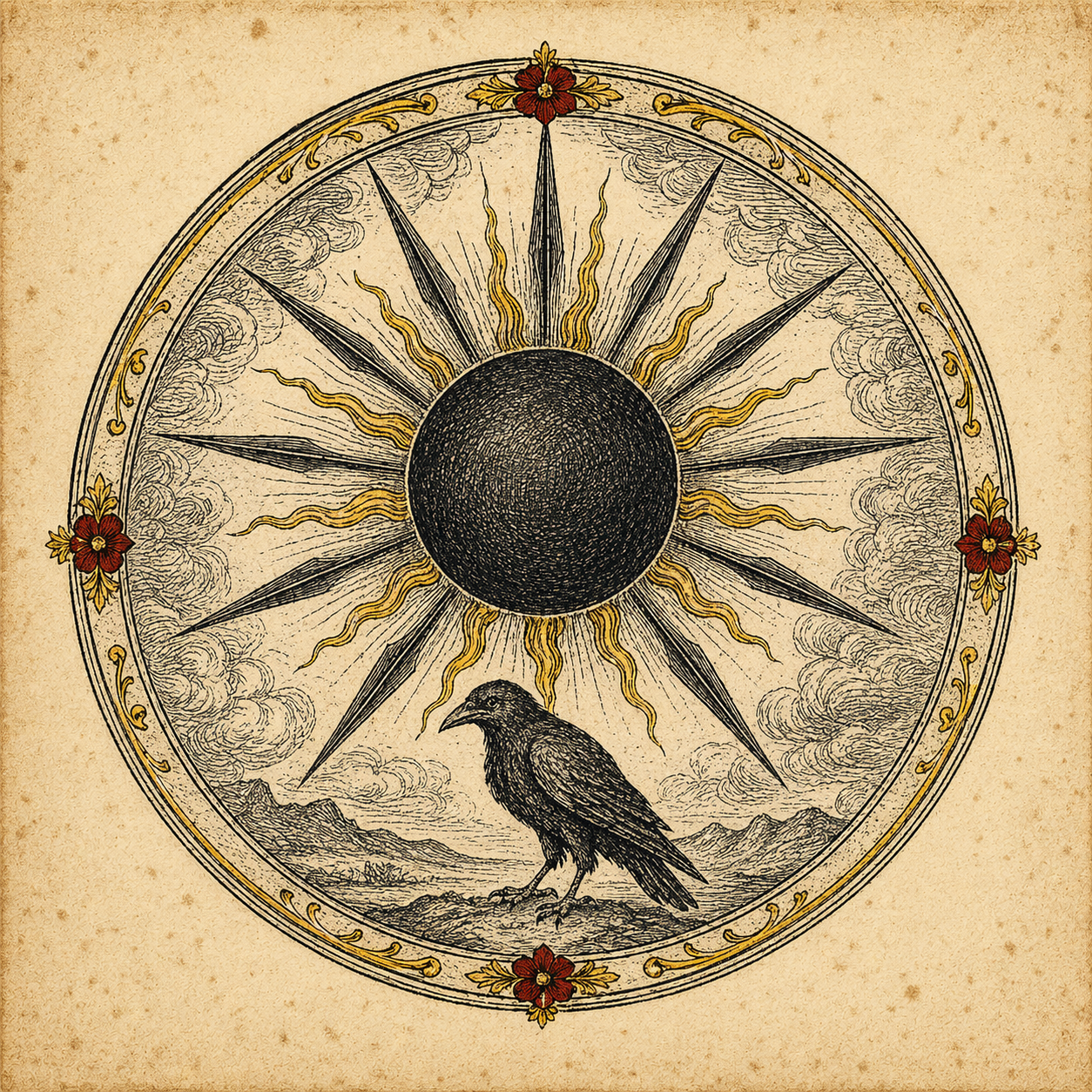
at the moment of Jesus’s death is the cosmic Sol Niger.
The source of all light is extinguished. The sun refuses to witness what is happening.
The cry from the cross — “Eloi, Eloi, lama sabachthani?” (Matthew 27:46),
the opening words of Psalm 22 — is the voice of Nigredo at its most absolute:
the experience of divine abandonment, of God-forsakenness, of the disappearance of every
consolation, every confirmation, every sense of divine presence. The one who is himself
the Sol — the Sun of Righteousness, the light of the world —
cries out from the darkness. The Sun has gone black.
For the Christian alchemist, this is not merely analogy. The Passion is the
archetype of Nigredo — the pattern that every subsequent night of the soul
participates in, the primal event that gives all darkness its hidden shape.
When the soul is in its Nigredo, it is not merely like Christ on the cross.
In some real sense, through baptismal incorporation, it is there.
From noon until three in the afternoon darkness came over all the land.
About three in the afternoon Jesus cried out in a loud voice,
“Eli, Eli, lema sabachthani?” (which means “My God, my God, why have you forsaken me?”)
Matthew 27:45–46
✠
II. The Dark Night of the Soul
John of the Cross (1542–1591), the Spanish Carmelite mystic and theologian,
gave the Church’s most precise and courageous analysis of spiritual Nigredo in his poem and
commentary La Noche Oscura del Alma — The Dark Night of the Soul.
John describes a two-fold process of purgation: the night of the senses, in which God withdraws
the felt consolations of prayer and devotion; and the night of the spirit, in which even the
soul’s most refined spiritual faculties are stripped bare and left in darkness.
What makes John’s analysis so alchemically precise is his insistence that the Dark Night
is not a sign of God’s absence but of his most intimate and purifying presence.
The darkness is caused not by God being far away but by his light being so intensely close
that the unpurified soul cannot perceive it as light — it experiences it as darkness,
as the burning away of everything that is not God. The Nigredo is the divine fire at work.
John also insists on the necessity of passivity in the Dark Night. The soul must not
try to illuminate its own darkness by artificial means — by forcing consolations, by fleeing
into activity, by seeking spiritual experiences to replace those that have been taken away.
The mortificatio must be endured. This is not passive resignation
but the deepest form of active trust: the willingness to remain in the crucible.
✠
III. Baptismal Death and the Font as Crucible
Paul’s theology of baptism in Romans 6 is alchemical Nigredo in its most liturgically
concentrated form: “We were therefore buried with him through baptism into death in order
that, just as Christ was raised from the dead through the glory of the Father,
we too may live a new life” (Romans 6:4).
The baptismal font is not merely a place of washing. It is a crucible. The candidate goes
down into it as into a grave; what emerges is not the same person who went in.
The early Church gave visible expression to this in the shape of the baptismal pools,
often cruciform or coffin-shaped — the architecture encoding the theology.
The font is, simultaneously, grave and womb: the place where the old self is interred
and the new creation is born. This double nature is Nigredo’s essence:
death and the seed of life occupy the same space, the same moment.
✠
IV. The Descensus ad Inferos: The Supreme Nigredo
The article of the Creed that has attracted the most theological controversy and the most
alchemical resonance is the descent into hell: descendit ad inferos.
Between the death on the cross and the resurrection at dawn, Christ descended into the place
of the dead — into the darkest, most God-forsaken region of creaturely existence.
The patristic tradition of the Harrowing of Hell — Christ descending into Hades
to release the imprisoned dead, preaching to those who had died before the Incarnation —
reads this descent as an act of supreme mortificatio that is
simultaneously an act of supreme liberation. The Lord of Life enters the kingdom of death
not to be defeated by it but to transform it from within. He goes all the way down —
further than any human Nigredo, further than any dark night — and finds that even there,
in the very centre of death and abandonment, the divine life is not absent.
It has preceded him.
This is the theological heart of the Sol Niger:
the black sun is still the sun. Even in the eclipse, the light is not extinguished —
it is concentrated, hidden, waiting. The descensus guarantees
that no human darkness is beyond transformation, because the one who is transformation
himself has been there first.
✠
V. The Exile as Nigredo
The wilderness motif runs through Scripture as one of its great structuring images.
Israel in the Sinai — forty years of stripped identity, of manna in the desert,
of the death of an entire generation before the promised land.
Elijah under the broom tree, exhausted and asking to die (1 Kings 19:4).
The psalmist in Psalm 88, the darkest of the psalms, which ends without resolution,
without the customary turn to praise — darkness upon darkness, no dawn visible.
These are Nigredo seasons. They are not punishments — or not only punishments.
They are the furnace. The identity forged in comfort and security must be stripped
to find what lies beneath it, what is genuinely one’s own rather than merely inherited
or performed. The exile from everything familiar — from home, from role, from the self
one thought one was — is the putrefactio of the false self,
the terrifying and necessary precondition of the new creation.
The exile is the beginning of the Opus. The person who has never been in Nigredo
has not yet begun the Great Work.