A Manifesto for Generative Systems Theology
A Manifesto for Generative Systems Theology
The Kerygma Codex
Preamble: For a Faith that Heals, Not Harms
We stand in a time of profound spiritual fragmentation. Many who seek God find themselves navigating theological frameworks that, however well-intentioned, can inadvertently inflict spiritual injury, amplify shame, or demand exhausting performance. The language of faith, meant to be a source of life, too often becomes a source of pressure.
The Kerygma Codex is offered in response. It is a proposal for a gentle, trauma-aware, and coherent grammar for Christian formation. It is an invitation to a faith that is at once gentle enough to hold the wounded and rigorous enough to be trustworthy. This is not a new doctrine or a rulebook, but a shared language for repair: a commons of healing for a world marked by division and distress.
For a shorter orientation, see INTRODUCTION.md.
Our central vision is the cultivation of a repair ecology: a habitat where people can become whole, truthful, gentle, and safe under pressure. It is an invitation to a faith that feels less like a performance system and more like a garden of chapels: a place of rest, consent, and careful discernment where healing becomes natural.
1. The Crisis of Language: Why We Need a Gentle Grammar
The language we use to speak of God and the soul is not neutral; it is formative. The grammars of our faith shape our communities, our inner lives, and our capacity for love. When these grammars become fragmented, unsafe, or coercive, they can cause deep and lasting harm. They can produce shame, fear, and a constant low-grade spiritual performance anxiety, leaving people feeling perpetually inadequate.
The Kerygma Codex addresses this by offering a coherent formation grammar that integrates salvation, discernment, and communal life into a single, interconnected map. It provides a shared systems-analogy grammar for naming deep spiritual patterns without diagnosing, ranking, or controlling people. It is language built for stewardship, not ownership; for healing, not for harm.
This crisis demands more than better words. It demands an architecture of safety, where pastoral care is not an addendum but the very foundation of the grammar itself.
2. The Core Vision: A Grammar of Participation, Not a Mechanism of Control
Generative Systems Theology is a translation layer: a servant grammar that uses analogies from systems science to articulate the Church’s ancient formation wisdom with greater coherence, gentleness, and trauma-awareness.
It is not a theory of divine causality.
It does not replace doctrine, sacrament, or liturgy.
It exists solely to clarify how we participate in the life of the Triune God.
| A Grammar of Participation | Not a Mechanism of Control |
|---|---|
| Analogical and relational | Not mechanistic |
| Healing-oriented | Not performance-driven |
| Invitation by consent | Not coercive |
| Pastoral and discerning | Not diagnostic |
| Dispositional | Not transactional |
Non-Negotiable Invariant:
Never treat God as a mechanism, algorithm, or system object.
3. The Unyielding Center: The Cruciform Criterion
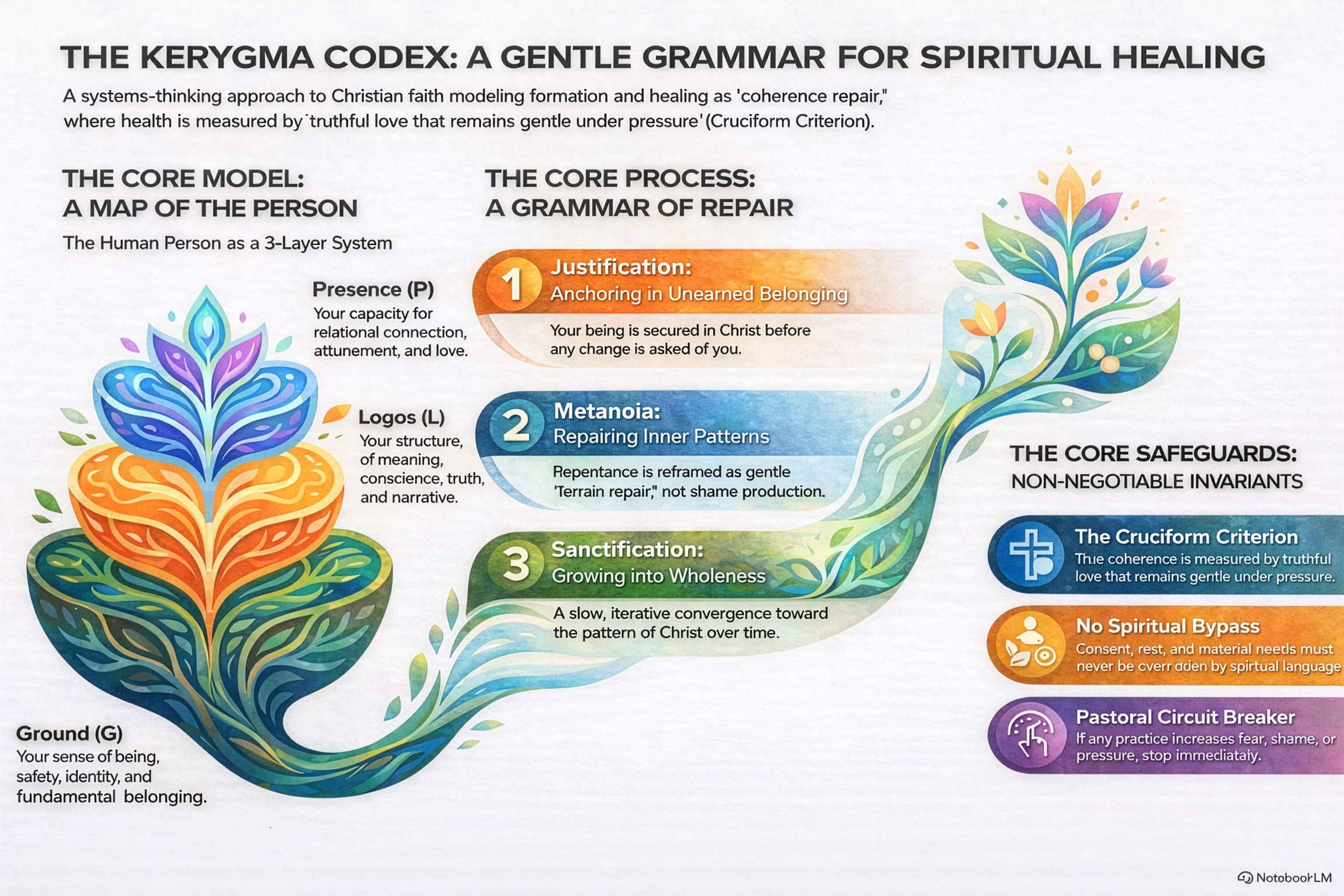
The Cruciform Criterion is the theological anchor and primary safeguard of the entire Codex.
Coherence is measured as:
Truthful love that remains faithful, gentle, and true under pressure.
Any stability that avoids the Cross is not coherence.
This criterion guards against triumphalism, self-optimisation spirituality, and spiritual performance anxiety. It ensures that all formation bends toward cruciform love, not comfort, dominance, or control.
4. The Architecture of Safety: Non-Negotiable Invariants
The Codex is built as a safe habitat for the soul, especially for those affected by trauma.
Its core invariants are:
-
Pastoral Circuit Breaker
If use of this Codex increases pressure, shame, fear, or performance anxiety — stop immediately. -
No Spiritual Bypass
Consent, safeguarding, creaturely limits, and material needs must never be overridden by spiritual language. -
Trauma Is Not Spiritual Failure
Illness, trauma, grief, neurodivergence, and depression are never signs of spiritual deficiency. -
No Diagnosing Others
The Codex is for self-examination and communal repair — never for ranking or labelling. -
Grace Is Gift
Practices dispose the heart; they do not manufacture God. -
Rest Is Holy
Any theology that cannot tolerate Sabbath is not generative.
Safety is structurally encoded: every Codex term explicitly includes pastoral risks, consent boundaries, and failure modes.
5. The Grammar in Motion: A Map of Healing
The Codex models the person as an analogical, relational system:
H = (G, L, P, A)
- G — Ground: Being, safety, belonging, identity
- L — Logos: Meaning, conscience, truth-making
- P — Presence: Relational attunement, communion, love-capacity
- A — Attractor Topology: Stable habit-patterns
Healing unfolds through the canonical operators:
- Justification — Anchors Ground in unearned belonging
- Metanoia — Repairs inner terrain
- Sanctification — Gentle iterative convergence
- Kenosis — Ego-noise reduction
- Nepsis — Watchful sobriety
- Koinonia — Distributed communal healing
- Theosis — Participation in divine life
- Glorification — Final Sabbath completion
All formation is measured by the Cruciform Criterion.
6. The Promise: Cultivating a Repair Ecology
The Codex does not aim to perfect a system, it aims to cultivate a habitat.
A repair ecology is a relational environment where healing becomes natural:
- Grace precedes effort
- Consent and safeguarding are honoured
- Healing is distributed across community
- Final hope is embodied restoration, not escape
7. An Invitation to a Gentle Faith
The Kerygma Codex is offered as a commons, a shared language for communities seeking a faith that heals rather than harms.
Its use is bound by this covenant:
If your intended use does not clearly preserve gentleness, truth, safety, consent, and human dignity, you do not have permission to use this work.
Let us cultivate a garden of chapels, not a rulebook.
Please keep it gentle.